I’ve sunk more hours into Genshin Impact than I’d care to admit. From grinding artifact domains until my eyes bled to simping over the latest five-star waifu, I always assumed my hard-earned (and sometimes wallet-drained) primogems were just lining MiHoYo’s pockets. Well, plot twist of the century – those pockets are actually bankrolling nuclear fusion research. Yeah, you heard that right. The same company that made you scream "YOLO" before pulling for Raiden Shogun is now trying to build an artificial star on Earth.
I’ve been following this journey since 2022, when MiHoYo first blew my mind by investing in a tiny tokamak startup. Fast-forward to 2026, and the Shanghai-based studio is no longer just the king of gacha; they’re a serious deep-tech player. It’s a classic "tech otakus save the world" moment, straight from their own motto, and I’m here for every glorious second of it.
From Waifu Wars to World-Saving Tech
Let’s rewind a bit. MiHoYo has been around since 2012, but it wasn’t until Genshin Impact dropped in September 2020 that they hit the global jackpot. That game was a gacha goldmine – over $2 billion in its first year on mobile alone, and by 2026 it has mushroomed across PC, console, and cloud versions, raking in well over $10 billion cumulatively. The art style is chef’s kiss, the character designs spark tribalist loyalty that would make a football fan blush, and the fan art community? Let’s just say the internet is very thirsty. But behind the waifu wars and endless resin grinds, the developers had a master plan: funnel that mountain of cash into bleeding-edge R&D.
Before they went nuclear, MiHoYo showed their futuristic leanings back in 2021. They teamed up with Shanghai Jiaotong University School of Medicine to launch a brain-computer interface lab. The goal? Neuromodulation therapy for depression. It sounded like something straight out of Sword Art Online, but that was just the appetizer. The main course came a year later when they dropped a $63 million funding round into Energy Singularity, a fusion startup staffed by brainiacs from Stanford, Princeton, Peking, Tsinghua, and Shanghai Jiao Tong University. I mean, that’s some Avengers-level talent roster.
Fusion: The Ultimate Endgame Boss
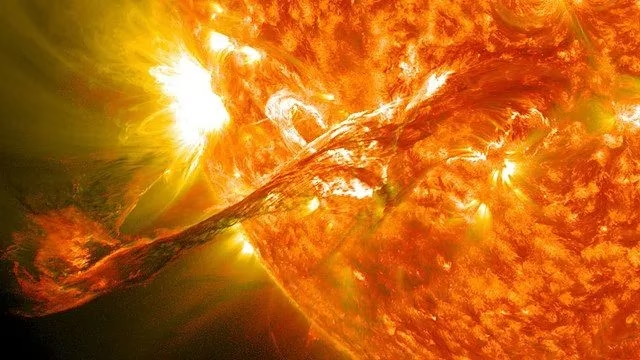
For anyone who slept through physics class, nuclear fusion is the holy grail of energy. It’s what powers our Sun – smashing atoms together under insane heat and pressure to release a ridiculous amount of energy. Unlike the fission reactors we use today (which split atoms and leave nasty radioactive waste), fusion is clean, safe, and runs on fuel you can extract from seawater. No greenhouse gases, no meltdown risks – just abundant electricity, basically a cheat code for civilization.
Energy Singularity’s game plan revolves around a device called a tokamak. Picture a donut-shaped magnetic cage that confines superhot plasma. By cranking up the magnetic fields, you force hydrogen isotopes to fuse, creating helium and a ton of energy. It’s like capturing a mini-sun inside a bottle. The boffins at Energy Singularity originally aimed to have a working tokamak by 2024, and here in 2026 they’ve actually made some serious headway. They achieved first plasma in late 2024 and have been steadily pushing toward net energy gain. Word on the street is they’re collaborating with ITER engineers and even testing high-temperature superconducting magnets that could make tokamaks smaller and cheaper – a real game-changer if it pans out.
Rolling for a Brighter Future
Here’s the kicker: all of this is partly funded by my gacha addiction. Every time you swiped that credit card for a C6 Eula or a Staff of Homa, a tiny fraction of that cash may have ended up in a superconducting coil or a plasma diagnostic sensor. It’s poetic, really. The same community that debates which character is "meta" is inadvertently backing a technology that could literally power the planet without cooking it. If Energy Singularity cracks commercial fusion in the next decade – and some experts are bullish – then I’ll remember this as the moment when Genshin Impact transcended gaming and became a footnote in energy history.
Of course, not everyone is sold. Critics say MiHoYo should stick to games, or that fusion is forever "30 years away." But I say, let them cook. Between the brain-computer interface lab and now fusion, MiHoYo is walking the walk on that "tech otaku" motto. And honestly? It makes me feel a little better about the months I spent in the Spiral Abyss salt mines.
The Road Ahead (and Some Hopium)
So where do we go from here? By 2026, Energy Singularity has already spun out subsidiaries focused on fusion materials and diagnostics. They’re a serious contender in the global race toward commercial fusion, alongside giants like Commonwealth Fusion Systems and Tokamak Energy. MiHoYo, meanwhile, continues to invest – they’ve topped up their funding twice since the initial round, and insiders hint they might integrate fusion-themed easter eggs into upcoming Genshin regions (Sumitech, anyone?).
If all goes well, we could see a prototype power plant by the early 2030s. And I’ll be there, probably still grinding for artifacts, but at least I’ll do it with the smug satisfaction that my gacha losses are heating a plasma chamber somewhere. So next time you’re about to rage-quit over another flat DEF piece, just remember: you’re not just building a team – you’re building a star. And that’s pretty freaking lit. ✨