In 2026, the name MiHoYo still instantly evokes sprawling landscapes, elemental combat, and a multi-billion-dollar gacha empire. The Shanghai-based studio behind Genshin Impact and Honkai: Star Rail has become a household name among gamers worldwide. Yet behind the curtain of its whimsical worlds, MiHoYo has been quietly nurturing an ambition that feels more at home in a physics laboratory than a game design document: harnessing the power of the stars through commercial nuclear fusion. This pursuit is not unlike trying to trap a star inside a glass jar—an audacious effort that could rewrite humanity’s energy story.
MiHoYo’s journey into the final frontier of clean energy began in earnest four years ago, when it emerged as a lead investor in Energy Singularity, a Shanghai-based startup founded by a cadre of experts from the world’s top universities. The company’s mission is deceptively simple: build a commercially viable tokamak reactor. A tokamak is a doughnut-shaped device that deploys immensely powerful magnetic fields to confine a superheated plasma of hydrogen isotopes, forcing atomic nuclei to fuse and release colossal amounts of energy. Think of it as a cosmic eggshell, tasked with cradling a tempest of charged particles so volatile that even a momentary breach would shatter the entire structure—and the dreams pinned to it.
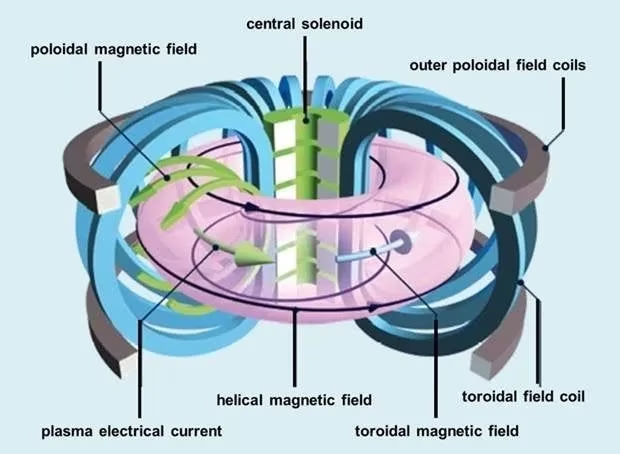
The first funding round in 2022 netted Energy Singularity $63 million, drawing support not only from MiHoYo but also from heavyweights like NIO Capital, Sequoia China’s Seed Fund, and BlueRun Ventures. That injection allowed the team to accelerate the development of a high-temperature superconducting tokamak, a design that benefits from decades of global research. Since then, the landscape has shifted dramatically. As of early 2026, Energy Singularity has reportedly achieved first plasma in its experimental device named HH70, a compact spherical tokamak that leverages rare-earth barium copper oxide (REBCO) magnets. This milestone—creating and sustaining a magnetically confined, million-degree plasma for a meaningful pulse—is the equivalent of a game’s tutorial boss: a necessary, sweat-inducing encounter that proves the core mechanics work before the real challenges begin.
The Fusion Gamble: Why a Game Studio Is Banking on a Miniature Sun
To grasp why MiHoYo has parked a portion of its Genshin-sized revenue in a physics moonshot, one must first understand the stakes. Commercial fusion has long been the holy grail of energy: a process that generates virtually limitless, carbon-free electricity using fuel derived from seawater and lithium. Unlike fission, there is no long-lived radioactive waste and zero risk of meltdown. The catch, however, is that sustaining the fusion reaction requires temperatures exceeding 100 million degrees Celsius—hotter than the core of the sun—while simultaneously maintaining an ultra-stable magnetic cage. This is akin to balancing a spinning top on the tip of a needle during an earthquake, and it has confounded engineers for generations.
The global fusion race has intensified in recent years, with over two dozen private companies now pursuing various reactor designs. The most famous government-led project, ITER (International Thermonuclear Experimental Reactor), is still under construction in southern France. Its central solenoid magnet is so powerful that it could, theoretically, lift an entire American aircraft carrier out of the ocean. Yet ITER’s timeline has been marred by delays and ballooning costs, and its first deuterium-tritium plasma is not expected until the late 2030s. This sluggishness has opened a window for leaner, faster-moving private ventures like Energy Singularity, which hope to demonstrate net energy gain—the point where a reactor produces more energy than it consumes—by the early 2030s.
MiHoYo’s involvement is not a random bet. The studio’s founders, Cai Haoyu, Liu Wei, and Luo Yuhao, met as postgraduate engineering students at Shanghai Jiao Tong University. Their shared love of anime initially propelled them into game development, but their academic DNA has always been wired to deep technology. The company’s motto, “Tech Otakus Save the World,” is not marketing fluff; it has shaped a portfolio that extends far beyond virtual loot boxes.
Tech Otakus Saving the World: More Than a Catchphrase
MiHoYo’s extracurricular investments read like a futurist’s wish list. In parallel with fusion, the company has poured resources into brain-computer interfaces, exploring direct communication pathways between the human brain and computers. It has also been an enthusiastic proponent of the metaverse—not just the commercialized, avatar-filled platforms, but the underlying infrastructure of digital twins, real-time rendering, and immersive AI. These ventures may seem disconnected, but they share a common thread: each aims to dismantle a fundamental barrier between humans and technology.
For MiHoYo, the fusion endeavor is the ultimate boss fight of science. Just as a gamer grinds for months to defeat a final raid boss, the studio is channeling its immense profits—Genshin Impact alone continues to generate billions annually—into a multi-decade quest for a star-in-a-box. After famously rebuffing a sizable investment from Tencent in its early years, MiHoYo has demonstrated a fierce independence that allows it to chase moonshots without shareholder pressure for short-term returns.
In a 2024 interview, an Energy Singularity executive noted that MiHoYo’s support goes beyond capital: the studio’s culture of iterative problem-solving and rapid prototyping has influenced the startup’s engineering sprint cycles. “They treat fusion development a bit like game patching,” the executive said. “You ship a minimum viable plasma, collect crazy amounts of data, and then iterate relentlessly.”
| MiHoYo’s Science & Tech Bets | Description | Status (2026) |
|---|---|---|
| Fusion Energy (Energy Singularity) | Compact spherical tokamak using high-temperature superconductors | First plasma achieved; aiming for net-energy by early 2030s |
| Brain-Computer Interfaces | Non-invasive and invasive neural interface research | In-house lab; partnerships with academic hospitals |
| Metaverse Infrastructure | Real-time worldwide rendering engine, digital twin tools | Backend powering Honkai: Star Rail and future titles |
| Quantum Computing (rumored) | Exploratory investments in cryogenic control chips | Early-stage, via venture arm |
From Virtual Worlds to Stellar Power
The connection between Genshin Impact’s Teyvat and a tokamak’s swirling plasma may feel tenuous, but the studio sees them as two sides of the same coin. Both rely on simulating complex, dynamic systems in real time. The same computational techniques that render anemo slimes fluttering in a breeze turn out to be invaluable for modeling plasma turbulence—one of the thorniest problems in fusion physics. MiHoYo’s proprietary game engines, which handle millions of concurrent interactions, are now being adapted to run magnetic confinement simulations, accelerating the design cycle for Energy Singularity’s next reactor iteration.
Moreover, the talent pipeline flows both ways. Scientists who spent years chasing plasma instabilities have joined MiHoYo’s AI division to build more believable NPC behavior, while game engine architects have contributed to the visualization tools used to debug real-world fusion experiments. This cross-pollination is rare but potent, a testament to the silo-breaking philosophy of the Tech Otaku creed.
The Road Ahead: Challenges as Large as a Star
Despite the encouraging milestones, the path to a commercial fusion power plant is still paved with formidable hurdles. Containing a burning plasma for hours or days requires materials that can survive neutron bombardment far more intense than anything in a fission reactor. Tritium breeding, the process of generating fuel inside the reactor itself, remains unproven at scale. And even if the physics pans out, the engineering of a cost-competitive, grid-connected plant is a challenge that will demand the patience of multiple funding cycles.
Energy Singularity’s HH70 is just the first step. The company plans a larger device, HH200, which would aim to generate 10 to 20 times the input power by the mid-2030s. Whether that timeline holds will depend on a constellation of factors: global supply chains for rare-earth superconductors, regulatory frameworks that don’t yet exist for commercial fusion, and, crucially, sustained investment from backers like MiHoYo through the inevitable dry seasons.
Yet if history has taught the tech world anything, it is that a small team of obsessed, well-funded engineers can collapse timelines that traditional institutions deem impossible. MiHoYo, a company that turned an anime-inspired open-world game into a cultural phenomenon, is now betting that the same alchemy can light a star on Earth. For the millions of players logging into Teyvat each day, the ultimate reward might not be a five-star character, but a carbon-free future—powered by the same fire that makes fictional worlds feel alive.